Structural clay tile describes a category of burned-clay building materials used to construct the walls of buildings and in structural fireproofing. Also called building tile, structural terra cotta or hollow tile, the material is an extruded clay shape with substantial depth that allows it to be laid in the same manner as other clay or concrete masonry. In North America it was chiefly used during the late 19th and early 20th centuries, and continues to be used in Europe to build fire-resistant walls and partitions. While most such units were intended to be covered with plaster or a similar finish material, structural glazed facing tiles (SGFT) have a glazed finish on one or more sides and are used as finish materials. In North America the material has largely been replaced by concrete masonry units.
Clay tile units
Hollow clay tile units were introduced in North America after 1875 for use as a lightweight, fire-resistant system for the construction of partitions in steel-framed buildings. Tile is classified into load-bearing and non-load-bearing categories. Load-bearing tile is described under ASTM Standard C34, subdivided into grade LBX, for areas exposed to weathering, and LB, for protected applications. Non-load-bearing tile is described under ASTM C56 in one grade, NB. It is used for interior partitions, and may be laid with cells running horizontally or vertically. Tile may be ribbed to accept a plaster finish, or smooth. Special shapes were available to attach to and to fit around structural steel shapes, providing a fire-resistant enclosure for the load-bearing steel members.
Structural clay tiles are manufactured in a variety of standard sizes, including 4″, 6″, 8″, 10″ and 12″ thicknesses, and typically 12″ x 12″ or 12″ x 8″ face dimensions. Tile was also manufactured in a series of graduated wedge shapes for installation between steel members as a fireproof flat arch floor structure, to be covered with a concrete wearing surface above. In other cases, structural clay tile was used as a permanent form material to reduce the bulk and weight of structural concrete floor slabs. Specialized kinds of structural clay tile were produced with a vitrified or glazed curved surface for use in building farm silos. Other shapes, called “telephone tiles”, were used as underground multi-celled conduits for telephone cables.
Structural glazed facing tile
Structural glazed facing tile has been extensively used in institutional settings where a durable, easily cleanable surface is desired. The material is commonly found in schools, correctional facilities, swimming pools and similar facilities. A wide variety of shapes have been developed to allow the construction of corners, caps, wall base and other elements using standard sizes. SGFT cannot be easily cut without damage to the glazed surface, so several dozen special shapes are available to allow most situations to be accommodated. SGFT features a fired glazed surface that may be produced in colors similar to those available from standard ceramic tile. SGFT has been replaced in some applications by glazed masonry units, a composite of concrete masonry and a tile-like surface coating.
Structural clay tile describes a category of burned-clay building materials used to construct the walls of buildings and in structural fireproofing. Also called building tile, structural terra cotta or hollow tile, the material is an extruded clay shape with substantial depth that allows it to be laid in the same manner as other clay or concrete masonry. In North America it was chiefly used during the late 19th and early 20th centuries, and continues to be used in Europe to build fire-resistant walls and partitions. While most such units were intended to be covered with plaster or a similar finish material, structural glazed facing tiles (SGFT) have a glazed finish on one or more sides and are used as finish materials. In North America the material has largely been replaced by concrete masonry units.
Clay tile units
Hollow clay tile units were introduced in North America after 1875 for use as a lightweight, fire-resistant system for the construction of partitions in steel-framed buildings. Tile is classified into load-bearing and non-load-bearing categories. Load-bearing tile is described under ASTM Standard C34, subdivided into grade LBX, for areas exposed to weathering, and LB, for protected applications. Non-load-bearing tile is described under ASTM C56 in one grade, NB. It is used for interior partitions, and may be laid with cells running horizontally or vertically. Tile may be ribbed to accept a plaster finish, or smooth. Special shapes were available to attach to and to fit around structural steel shapes, providing a fire-resistant enclosure for the load-bearing steel members.
Structural clay tiles are manufactured in a variety of standard sizes, including 4″, 6″, 8″, 10″ and 12″ thicknesses, and typically 12″ x 12″ or 12″ x 8″ face dimensions. Tile was also manufactured in a series of graduated wedge shapes for installation between steel members as a fireproof flat arch floor structure, to be covered with a concrete wearing surface above. In other cases, structural clay tile was used as a permanent form material to reduce the bulk and weight of structural concrete floor slabs. Specialized kinds of structural clay tile were produced with a vitrified or glazed curved surface for use in building farm silos. Other shapes, called “telephone tiles”, were used as underground multi-celled conduits for telephone cables.
Structural glazed facing tile
Structural glazed facing tile has been extensively used in institutional settings where a durable, easily cleanable surface is desired. The material is commonly found in schools, correctional facilities, swimming pools and similar facilities. A wide variety of shapes have been developed to allow the construction of corners, caps, wall base and other elements using standard sizes. SGFT cannot be easily cut without damage to the glazed surface, so several dozen special shapes are available to allow most situations to be accommodated. SGFT features a fired glazed surface that may be produced in colors similar to those available from standard ceramic tile. SGFT has been replaced in some applications by glazed masonry units, a composite of concrete masonry and a tile-like surface coating.
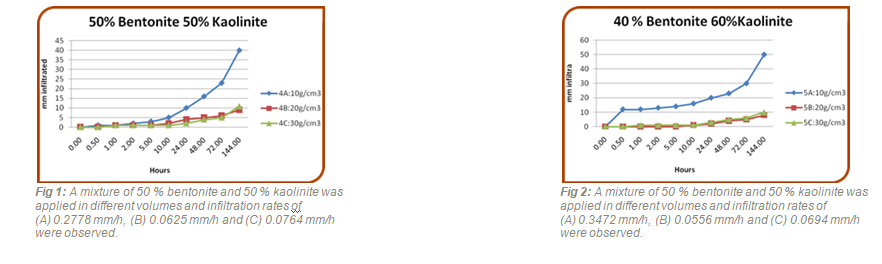
Clay liners are affordable but equally effective alternatives to commercial synthetic liners such as polythene, vinyl, butyl rubber or treating the soil chemically. It is also friendlier to the environment. Over the years it has become customary to use bentonite clay due to its unique swelling properties. Kaolinite however, is more affordable due to its availability.
Recent experimental studies conducted at the NWU showed that substituting a percentage of the required amount of bentonite with Atlas Clay Kaolinite is just as effective as using pure bentonite. Leaching columns, set up based on industry specifications observed the infiltration rates for 144 consecutive hours. The experimental results are depicted in the following figures.
The clay is used as an anti-cacking agent in the manufaturing of fertilizers.